
Coronado Tent City
The Whimsical Seaside Canvas Kingdom on the Silver Strand
For thirty-nine glorious summers between 1900 and 1939, Coronado was home to one of the most beloved and picturesque vacation communities in American history. Located on the narrow sandspit of the Silver Strand just south of the Hotel del Coronado, Tent City was a self-contained summer city under canvas, where ocean breezes, brass band concerts, and beach bonfires welcomed thousands of families each season.
Listen to the historical narrative via browser voice narration
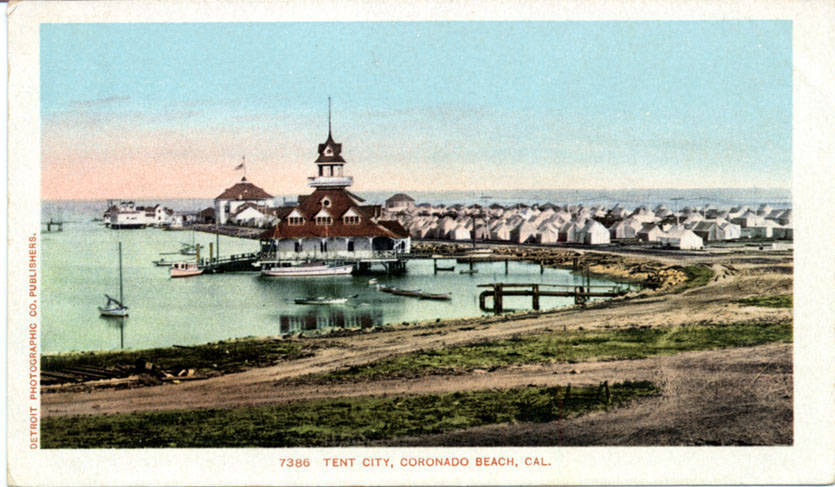
Coronado Tent City, John D. Spreckels’ famous summer resort with thatched-roof cottages, boardwalk games, and ocean bathing along the Silver Strand.
1. An Accessible Summer Paradise
In the late 1890s, John D. Spreckels recognized a growing civic dilemma: the luxurious Hotel del Coronado catered exclusively to the wealthy elite of New York, Chicago, and San Francisco. Meanwhile, ordinary working families from the hot inland valleys of California, Arizona, and Nevada were desperate for summer coastal relief but could not afford luxury hotel rates.
In June 1900, Spreckels unveiled Coronado Tent City. Laid out in neat, numbered grid streets on the oceanfront south of the hotel, it featured red-and-white striped canvas tents with wooden board floors, screened windows, electric lighting, and fresh piped water. For as little as $4.50 a week, a family could rent a furnished tent cottage and enjoy the Pacific ocean waves.
2. Life in the Canvas City: The Plunge & Band Pavilion
Tent City was far more than a campground; it was a vibrant, self-contained coastal resort town equipped with modern amenities and non-stop entertainment:
The Yellow Brick Road & The Whimsical Kingdom
During his Coronado winters from 1904 to 1910, L. Frank Baum frequently strolled south along the shoreline to Tent City. The sight of hundreds of striped canvas roofs fluttering in the ocean wind, children eating candied apples, and brass horns echoing across the surf mirrored the joyous festive gatherings of the Munchkins and Gillikins in his Oz books.
3. The Final Season: September 1939
By the late 1930s, the world was changing rapidly. The growing dominance of personal automobiles and modern motor courts altered vacation habits. More crucially, as World War II erupted in Europe, the United States Navy urgently needed the Silver Strand beaches for military mobilization.
In September 1939, Tent City concluded its thirty-ninth and final season. The tents were struck, the boardwalk dismantled, and the land was transferred to defense preparations that shortly became Naval Amphibious Base Coronado. Though the canvas cottages are gone, Tent City remains immortalized in thousands of vintage sepia photographs preserved in the Coronado Historical Association museum.
Share Chronicle & Academic Citation
Distribute verified Coronado historical records or cite this resource in academic, educational, and journalistic works.