North Island: Birthplace of Naval Aviation
Where Human Flight Met the Sea & Changed Warfare Forever (1911-Present)
Before aircraft carriers existed, naval officers looked to the sky with profound skepticism. On the quiet tidal waters of Spanish Bight and the windswept sandspit of North Island, visionary aviation pioneer Glenn H. Curtiss proved that airplanes could land upon and take off from the water. Coronado earned its eternal place in military annals as the cradle of all carrier aviation and naval special warfare.
Listen to the historical narrative via browser voice narration
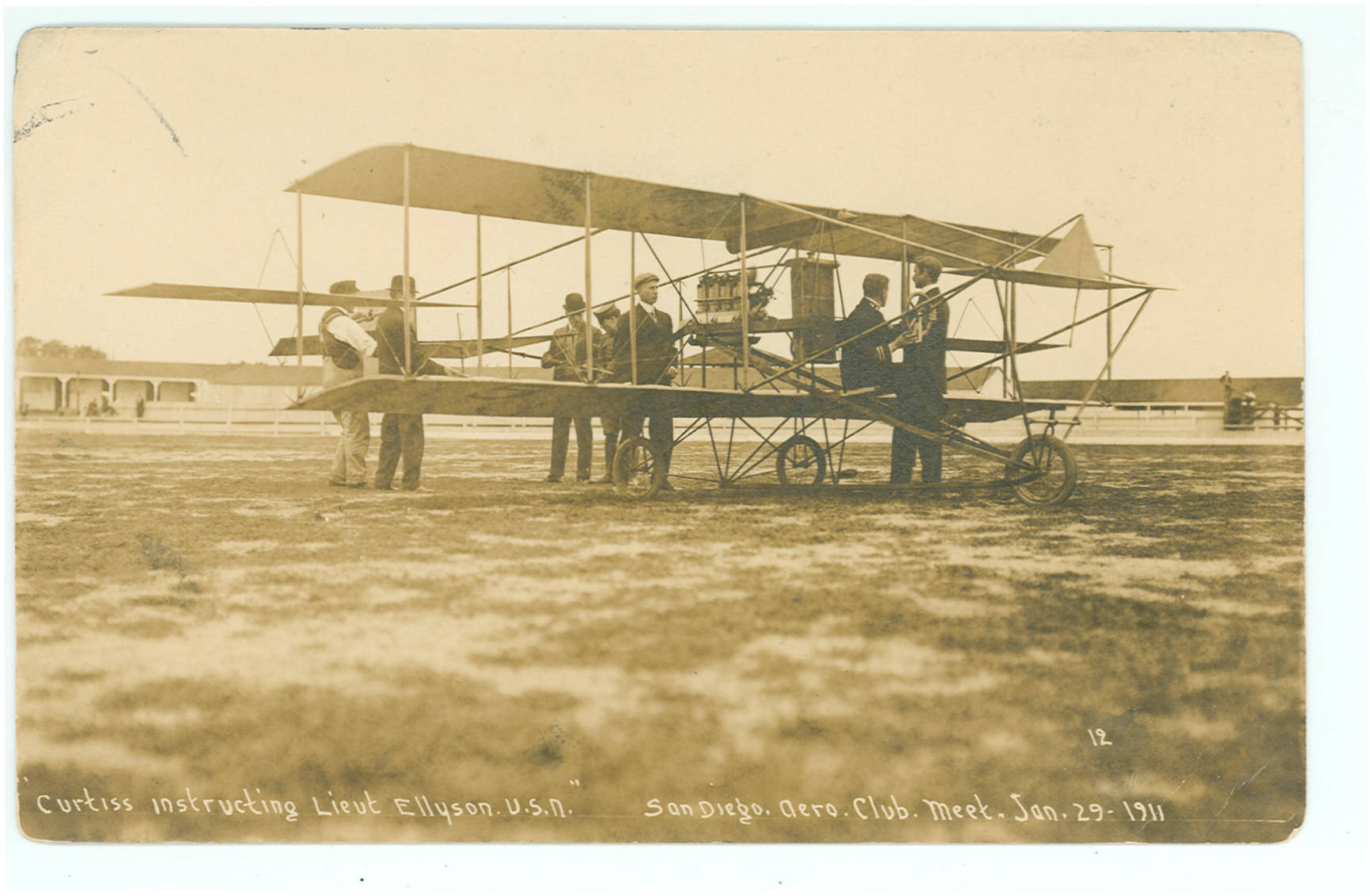
Aviation pioneers and Curtiss aeroplanes gathered on the sands of North Island in January 1911, establishing Coronado as the cradle of American naval flight.
1. Glenn Curtiss & The Flight on Spanish Bight
In late 1910, Glenn H. Curtiss of Hammondsport, New York, offered to train army and naval officers in aviation free of charge if a suitable winter testing site could be provided. The Coronado Beach Company eagerly offered the uninhabited sands of North Island, then separated from Coronado proper by a narrow tidal waterway known as Spanish Bight.
Curtiss set up a camp of wooden shacks and canvas hangars. On January 26, 1911, Curtiss climbed into his newly constructed biplane fitted with a central pontoon, the "hydroaeroplane." He lifted off from the calm waters of Spanish Bight, flew a circuit across the bay, made a gentle water landing, and taxied back to the beach. It was the first successful seaplane flight in history.
2. Lieutenant Theodore G. Ellyson: Naval Aviator No. 1
The Navy Department ordered twenty-six-year-old submarine officer Lieutenant Theodore Gordon Ellyson to report to Curtiss at North Island for flight instruction. Ellyson mastered Curtiss’s dual-control aircraft, assisted in engineering pontoon hull shapes, and tested the first catapult launch of an aircraft from a floating dock.
In 1911, the Navy officially designated Ellyson U.S. Naval Aviator No. 1, issuing him the gold naval aviator wings that founded the entire naval air service.
3. Charles Lindbergh & The Spirit of St. Louis (1927)
During the 1920s, North Island served dual military duty as the Army’s Rockwell Field and the Navy’s NAS North Island. In the spring of 1927, twenty-five-year-old airmail pilot Charles A. Lindbergh arrived in San Diego to supervise the custom manufacture of the Spirit of St. Louis by Ryan Airlines.
To test the monoplane with a dangerous, unprecedented fuel load of 450 gallons, Lindbergh utilized the long, unobstructed military runways of Rockwell Field on North Island. On May 10, 1927, Lindbergh lifted off from North Island, set a transcontinental speed record to St. Louis, and ten days later flew from New York to Paris in the first solo nonstop transatlantic crossing.
4. World War II & Infilling Spanish Bight (1944-1945)
During World War II, NAS North Island was the supreme aircraft carrier staging hub of the Pacific Fleet. To accommodate larger four-engine transport bombers and jet aircraft:
5. Naval Amphibious Base Coronado & The Navy SEALs
In 1943, the Navy established the Naval Amphibious Base Coronado on the Silver Strand. Under combat conditions in the cold Pacific surf, Rear Admiral Draper Kauffman founded the Underwater Demolition Teams (UDT), the "Frogmen", who swam into enemy beaches to clear coral reefs and mines ahead of Allied landings.
In the 1960s, this lineage created the elite United States Navy SEALs. Today, Basic Underwater Demolition/SEAL (BUD/S) training at NAB Coronado is globally recognized as the crucible of maritime special operations brotherhood, discipline, and lionhearted courage.
Share Chronicle & Academic Citation
Distribute verified Coronado historical records or cite this resource in academic, educational, and journalistic works.