
The Coronado Boathouse (1887)
The Victorian Architectural Rehearsal for Hotel del Coronado
Resting gracefully on heavy timber pilings over the tranquil waters of Glorietta Bay, the Coronado Boathouse was erected in late 1887, months before Hotel del Coronado opened its doors. Designed by Canadian-born architects James and Merritt Reid, this exquisite Queen Anne pavilion served as an audacious architectural trial run for the construction techniques, cupolas, and wood framing that would make the Del famous worldwide.
Listen to the historical narrative via browser voice narration
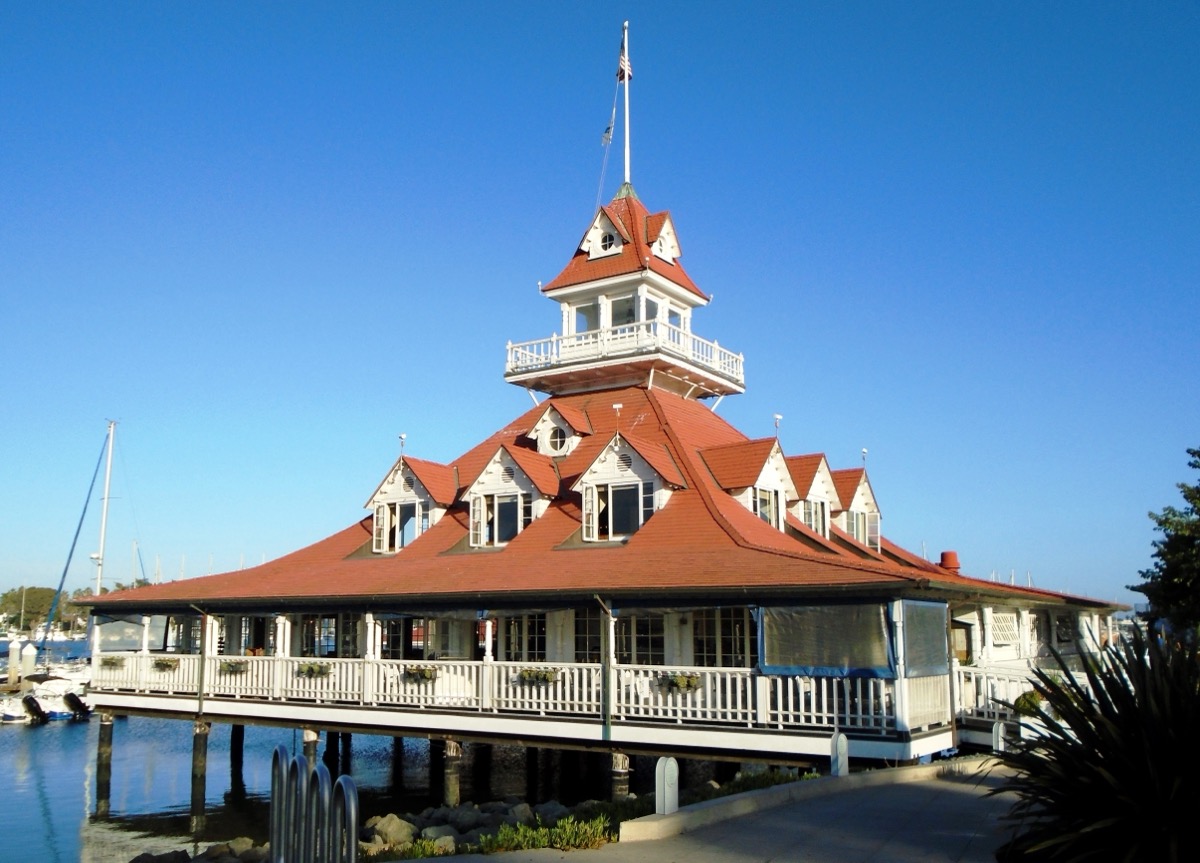
Erected in 1887 by the Reid Brothers as an architectural test run for Hotel del Coronado; designated Coronado Historic Landmark #1.
1. The Architectural Rehearsal for a Masterpiece
When Elisha Babcock and Hampton Story recruited young Indiana architects James W. Reid and his brother Merritt to design Hotel del Coronado, the Reids were taking on an unprecedented undertaking: constructing what would be the largest wooden building in the United States using green Douglas fir shipped from the Pacific Northwest.
To test how unseasoned timber behaved in Southern California's marine air and to evaluate the complex mathematical geometry of their multi-tiered Victorian roof pitches and cupolas, the Reids ordered construction of the Boathouse first. In December 1887, the structure was completed on the tidal mudflats of Glorietta Bay for $6,500.
Crowned with an octagonal shingled cupola, broad covered wrap-around verandas, and heavy redwood brackets, the Boathouse proved that the Reid brothers' structural framing system was sound. Satisfied with the results, the carpenters turned their full energy across Strand Way to complete the grand hotel for its February 1888 opening.
2. Yachting Capital of Southern California (1900-1914)
The Boathouse immediately transformed Glorietta Bay into California's premier aquatic playground. The hotel maintained an extensive private fleet of lapstrake rowing skiffs, canoes, and motorized launches for hotel guests, who enjoyed fishing excursions into the bay and moonlight rows along the quiet shoreline.
In 1900, the San Diego Yacht Club signed a long-term lease with the Coronado Beach Company, designating the Boathouse as its official clubhouse and headquarters. For fourteen golden years, Victorian yachting ensigns flew from its flagpole, and the waters of Glorietta Bay were filled with sailing sloops, gaff-rigged ketches, and racing schooners competing for Pacific Coast trophies.
Coronado Boathouse Architectural Specifications
| Feature | Archival Specification | Historical Purpose |
|---|---|---|
| Architectural Style | Queen Anne Victorian with Eastlake Detailing | Prototype for Hotel del Coronado's towers |
| Foundation Structure | Creosoted Douglas Fir Piling Grillage | Elevated over Glorietta Bay tidal flats |
| Central Cupola | Octagonal Shingled Lantern Cupola | Observation deck and ventilation lantern |
| Original Footprint | Two Stories / 4,200 Square Feet | Boat storage lower level, social salon upper level |
| Municipal Designation | Coronado Historic Landmark #1 (1974) | First building protected under city preservation law |
3. The Tent City Era & Summer Regattas (1900-1939)
When John D. Spreckels opened Coronado Tent City in 1900, the Boathouse formed its northern boundary. Connected by wooden boardwalks to the canvas city, vacationing families rented canvas canoes by the hour.
On warm summer evenings, the Boathouse was illuminated with hundreds of multi-colored paper lanterns. Strains of waltz music drifted across the bay from the Tent City Band, and illuminated flotillas of decorated boats paraded past its balconies in celebrated carnival pageants.
4. Historic Adaptive Reuse: From The Chart House to Bluewater
Following World War II and the departure of the yacht clubs, the wooden building suffered from decades of marine exposure. In 1968, visionary preservation-minded restaurateurs stepped in, undertaking a painstaking restoration of the Douglas fir beams and Queen Anne woodwork to open the legendary Chart House.
Recognizing its irreplaceable status as the oldest surviving building of the 1880s boom, the Coronado City Council designated it as Coronado Historic Landmark #1 in 1974. Operating today as the Bluewater Boathouse Seafood Grill, the landmark remains in pristine condition, offering patrons waterfront dining amidst century-old maritime artifacts.
Frequently Asked Questions: Coronado Boathouse
Why was the Coronado Boathouse built before Hotel del Coronado?
Architects James and Merritt Reid built the Boathouse in late 1887 as an architectural trial run. It allowed them to test construction techniques, green timber curing in sea air, and the complex geometry of their Queen Anne shingle turrets before committing to the massive scale of Hotel del Coronado.
What is the historical significance of Coronado Landmark #1?
In 1974, the City of Coronado formally designated the Boathouse as Historic Landmark #1 because it was the earliest completed permanent resort structure on the peninsula, preceding the opening of Hotel Del by two months.
Did the San Diego Yacht Club occupy the Coronado Boathouse?
Yes. In 1900, the San Diego Yacht Club leased the Boathouse as its official headquarters and clubhouse, hosting Pacific regattas and championship sailing matches on Glorietta Bay until relocating to Point Loma in 1914.
What is the Coronado Boathouse used for today?
The building has been meticulously preserved and operates today as the Bluewater Boathouse Seafood Grill. Guests dine inside the restored Victorian timber-framed interior, surrounded by historic rowing shells and vintage maritime artifacts overlooking Glorietta Bay.