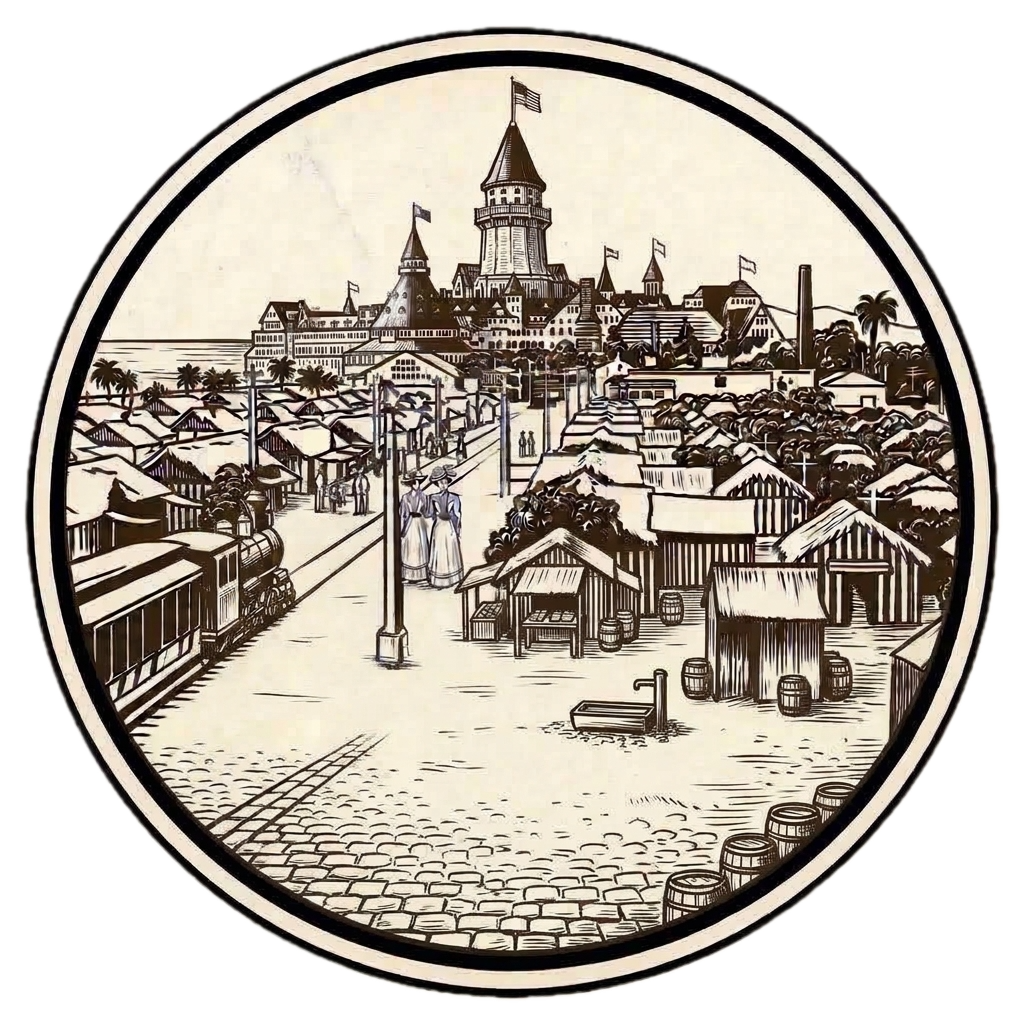
The Coronado Railroad & Steam Dummy Era
When Steam Locomotives Chugged Down Orange Avenue and Encirled the Entire Bay
Before asphalt boulevards, automobiles, or electric trolleys existed in southern California, the founders of the Coronado Beach Company laid heavy steel rails directly through the sand of Orange Avenue. Starting in 1886, passenger trains powered by camouflaged "steam dummy" locomotives carried hotel guests, investors, and millions of board-feet of northern pine timber directly from the bay ferry slips to the ocean beach.
Listen to the historical narrative via browser voice narration
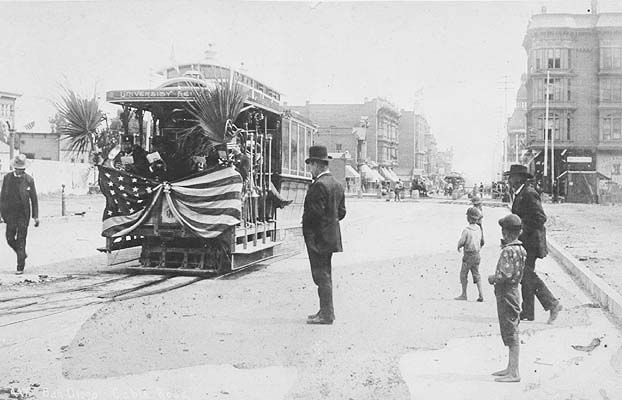
Opening day of the Coronado Railroad in 1888, connecting the ferry landing along Orange Avenue to the Hotel del Coronado and the 22-mile Belt Line.
1. The Steam Dummy Camouflage on Orange Avenue (1886-1888)
When Elisha Babcock Jr. surveyed the unpaved scrub of the peninsula in late 1885, he understood that guests arriving at the bay ferry slip on First Street would never walk a mile through soft sand to reach the ocean beach where Hotel del Coronado was rising. Horse-drawn streetcars were considered too slow and had limited pulling power for heavy construction freight.
The solution was the incorporation of the Coronado Railroad Company in April 1886. Standard-gauge track was driven directly down the central 100-foot right-of-way of Orange Avenue. To power the trains through populated residential neighborhoods without frightening horse teams, the company ordered specialized "steam dummy" locomotives manufactured by the Baldwin Locomotive Works in Philadelphia.
A steam dummy was an ordinary coal-burning steam engine wrapped entirely inside an ornate wooden coach body with glass sash windows and painted gold leaf lettering. The smokestack was vented discreetly through the roof, and the clattering iron pistons were shielded by lower skirting. To an approaching carriage horse or visitor, the machine resembled an ordinary streetcar gliding peacefully down the tracks.
2. The 21.8-Mile Belt Line Around San Diego Bay
Babcock’s ambition extended far beyond a one-mile shuttle. In 1887, he initiated construction on one of the most scenic rail corridors in California history: the Coronado Belt Line.
Completed in 1888, the line measured 21.8 miles. Passenger trains departed downtown San Diego at the terminal at 5th and L Streets, curved southeast through National City and Chula Vista, swept around the salt ponds of the south bay, and then roared north along the narrow knife-edge of the Silver Strand, with the Pacific breakers crashing just yards from the right-of-way.
The train entered Coronado along Glorietta Bay, looped around the grounds of Hotel del Coronado, and continued up Orange Avenue to the ferry slip. Travelers could board a train in downtown San Diego, enjoy an open-air excursion around the bay, disembark at the hotel's private depot, and return to San Diego by steam ferry, creating an unforgettable tourist excursion that made Coronado internationally famous.
Coronado Railroad Archival Specifications
| Parameter | Steam Dummy Era (1886) | Belt Line Excursion (1888) | Electric SDERy Era (1904-1939) |
|---|---|---|---|
| Locomotive Type | Baldwin Enclosed 0-4-0 Steam Dummy | Standard 4-4-0 Steam Passenger Locos | Double-Truck Overhead Electric Trolleys |
| Track Gauge | Standard (4 ft 8.5 in) | Standard (4 ft 8.5 in) | Standard (4 ft 8.5 in) |
| Route Mileage | 1.2 Miles (Orange Ave) | 21.8 Miles (Full Bay Loop) | Route 9 Urban & Interurban Grid |
| Fare Schedule | 5 Cents | 50 Cents (Round-Trip Belt Excursion) | 5 Cents / Commuter Tokens |
| Freight Transport | Hotel Lumber, Brick, Ice | Otay Salt, Agriculture, Cattle | Naval Freight to North Island |
3. John D. Spreckels and the Electric Streetcar Transformation (1904)
By the turn of the century, the soot, smoke, and noise of coal-fired steam engines clashed with the luxury atmosphere of Hotel del Coronado and the peaceful summer canvas colony of Tent City.
In 1904, John D. Spreckels purchased the Coronado Railroad and consolidated its assets into the San Diego Electric Railway (SDERy). Spreckels invested heavily to electrify the trackage, stringing copper catenary lines from the Glorietta Bay powerhouse and laying double tracks down the landscaped parkway median of Orange Avenue.
Numbered as SDERy Route 9, the handsome green-and-cream streetcars provided frequent, zero-emission service every ten minutes. Guests in tuxedos and evening gowns could step directly onto the streetcar platform outside the hotel ballroom and ride gracefully to the ferry slips or connect across the Silver Strand to downtown San Diego.
4. The Living Heritage: The Bayshore Bikeway
Streetcar service came to an end in Coronado in 1939 with the adoption of municipal motorized transit buses, and freight rail along the Silver Strand ceased in the late 1960s. However, rather than being paved over with commercial strip malls, the historic right-of-way was permanently preserved.
Today, the 24-mile Bayshore Bikeway follows the exact trajectory of Babcock’s 1888 Belt Line. Hundreds of thousands of cyclists, runners, and nature enthusiasts each year ride along the original railroad grade, enjoying the uninhibited maritime views across the San Diego Bay National Wildlife Refuge.
Frequently Asked Questions: Coronado Railroad History
What was a 'steam dummy' locomotive on Orange Avenue?
A steam dummy was a small coal-fired steam locomotive enclosed inside a wooden passenger coach body. This ingenious architectural camouflage concealed the noisy reciprocating pistons, rods, and smokestack so that carriage horses trotting along Orange Avenue would not panic and bolt.
What was the 21.8-mile Coronado Belt Line railroad?
Completed in 1888, the Coronado Belt Line was a full-loop railway encircling the perimeter of San Diego Bay. Passenger and freight trains departed downtown San Diego at 5th & L Streets, ran south through National City and Chula Vista, traveled up the Silver Strand sandspit, and terminated at Hotel del Coronado.
When was the Coronado railroad electrified into streetcars?
In 1904, sugar magnate John D. Spreckels consolidated the Coronado Railroad into the San Diego Electric Railway (SDERy). He retired the steam locomotives, erected overhead electrical catenaries, and introduced sleek electric streetcars (Route 9) running down the landscaped center median of Orange Avenue.
Can you still see or walk the historic Coronado Railroad route today?
Yes. The historic railbed along the Silver Strand has been preserved as the scenic Silver Strand Bikeway and Bayshore Bikeway, where cyclists and walkers travel the exact 1888 railroad grade between Coronado and the mainland.