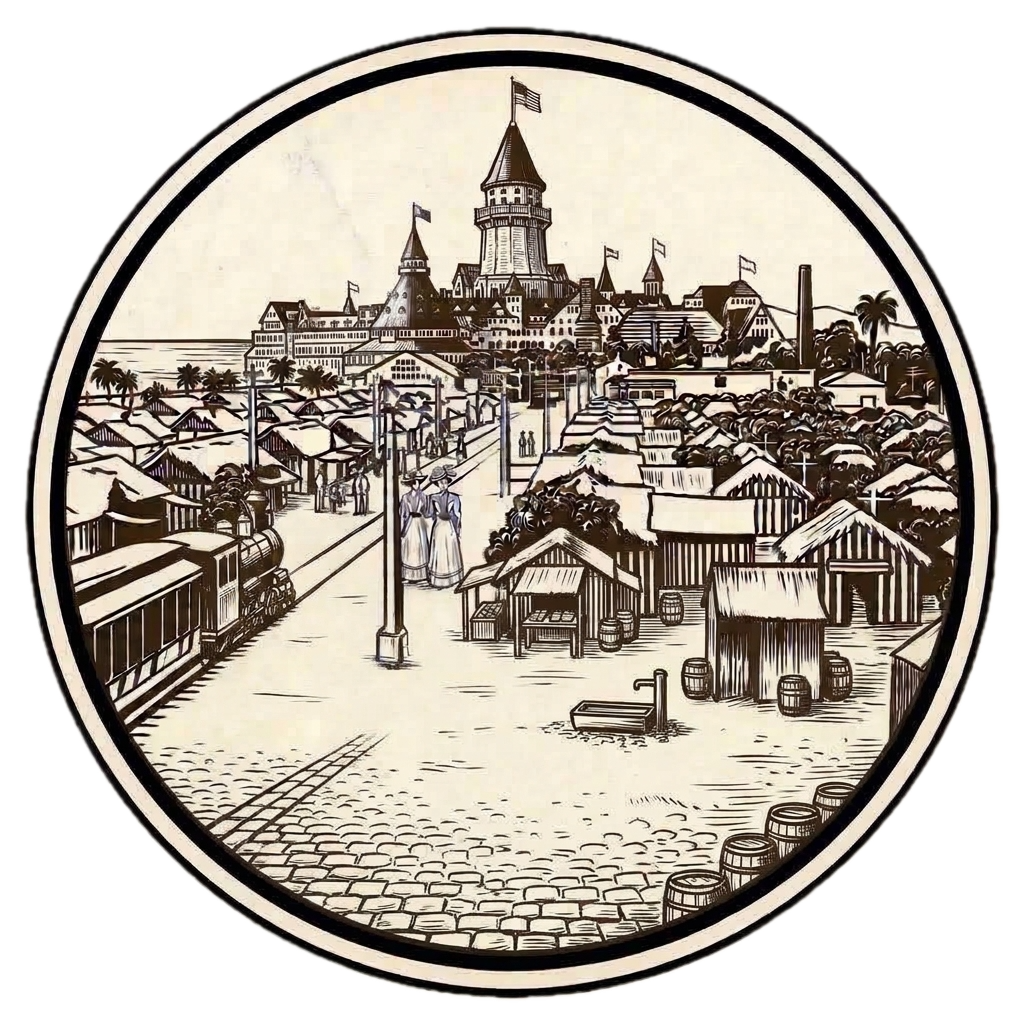
The Coronado Ferry Era (1886-1969)
Eighty-Three Years of Floating Commuting, Victorian Paddlewheels, and Maritime Romance
Before the soaring blue spans of the San Diego-Coronado Bridge arched across the harbor in August 1969, the only maritime artery connecting the city of San Diego with the Crown City was by boat. For more than eight decades, the Coronado Ferry was the living heartbeat of the peninsula, a daily ritual where newsboys hawked papers, naval admirals stood side-by-side with shipyard welders, and children tossed crusts to gliding sea gulls.
Listen to the historical narrative via browser voice narration
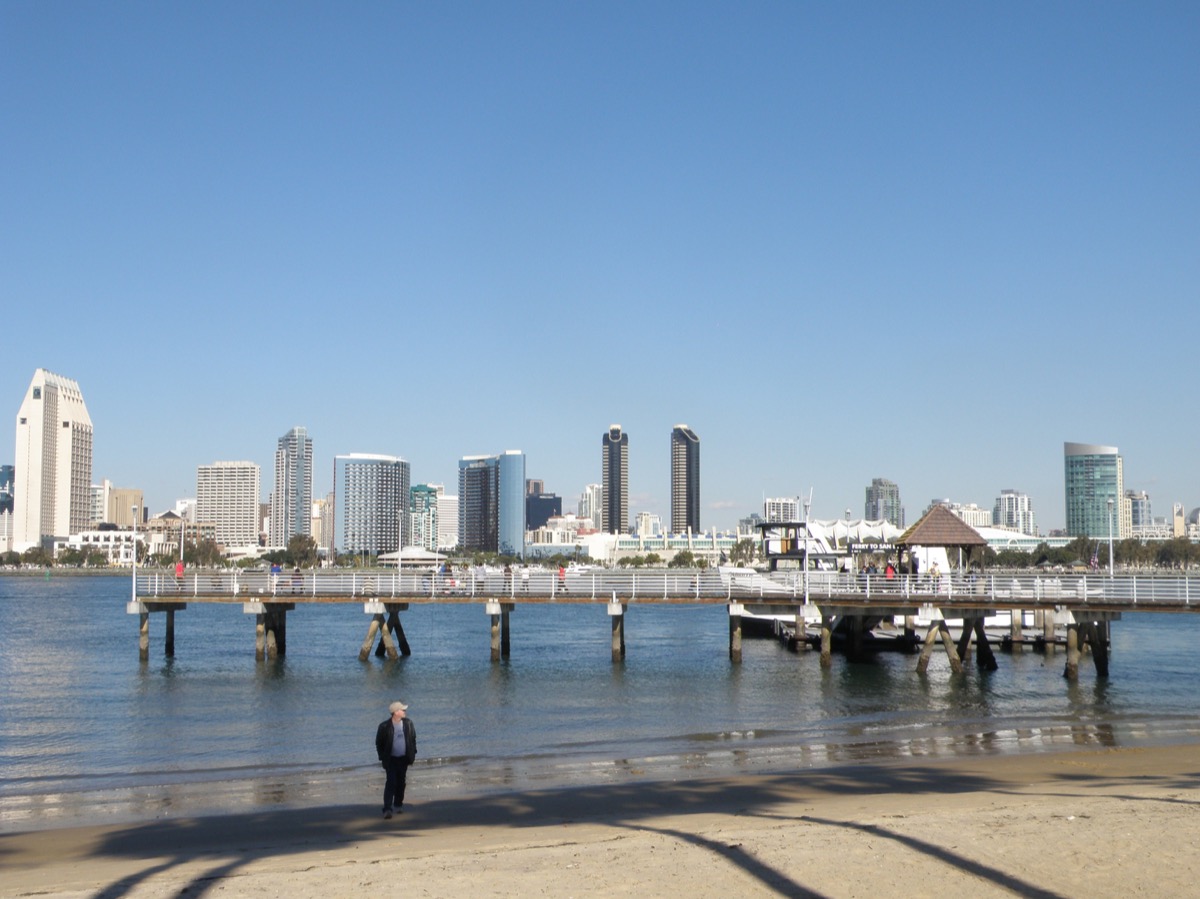
The historic ferry transit route connecting the foot of Market Street in San Diego to the 1st Street ferry landing in Coronado.
1. From Rowboats to the Side-Wheel Steamer Silver Gate (1886-1888)
In late 1885 and early 1886, prospective land investors arriving in San Diego had to negotiate with commercial boatmen at the foot of Fifth Avenue to be rowed across the harbor in open whaleboats or small steam launches. During rough weather, passengers were routinely soaked with salt spray before stepping ashore onto Coronado’s sandy mudflats.
Recognizing that the success of Hotel del Coronado required an elegant, weatherproof arrival experience, Elisha Babcock and Hampton Story incorporated the Coronado Ferry Company in April 1886. They immediately constructed deep-water pilings and ferry slips at the foot of Orange Avenue on First Street.
In 1888, the company placed in service the grand paddlewheeler Silver Gate. Built in San Francisco for $65,000, she was a magnificent 160-foot side-wheel steamer with an ornate Victorian cabin salon, hand-carved mahogany bench seating, cut-glass lanterns, and large observation windows. For a fare of just five cents, guests enjoyed a serene seven-minute voyage across the bay, serenaded by chamber musicians hired by the hotel.
2. The Spreckels Revolution: The Historic Ramona (1903)
When John D. Spreckels acquired the Coronado Beach Company and ferry franchise in the 1890s, he recognized that wood-hulled paddle steamers were vulnerable to marine borers and boiler explosions. Drawing upon his naval architects, Spreckels commissioned a groundbreaking vessel that changed maritime transit along the West Coast.
Launched in 1903, the Ramona was the very first double-ended steel-hull passenger ferry boat ever constructed on the Pacific Coast. Equipped with twin screw propellers on both bows and stern, the Ramona eliminated the cumbersome necessity of backing out of slips or turning around in mid-channel. She could dock smoothly from either direction, cutting turnaround times in half and dramatically reducing coal consumption.
The Great Coronado Ferry Fleet (1888-1969)
Original Victorian resort flagship
1st steel double-ender on West Coast
Pioneered early auto commuting
Served the massive WWII naval rush
Final auto ferry built; radar equipped
| Vessel Name | Launch Year | Hull & Propulsion | Capacity | Historical Distinction |
|---|---|---|---|---|
| Silver Gate | 1888 | Wood / Side-Wheel Paddle | 800 Passengers | Original Victorian resort flagship |
| Ramona | 1903 | Steel / Double-Ended Steam | 1,000 Passengers | 1st steel double-ender on West Coast |
| Morena | 1920 | Steel / Diesel Conversion | 40 Autos / 600 Pass. | Pioneered early auto commuting |
| San Diego | 1931 | Steel / Diesel-Electric | 60 Autos / 800 Pass. | Served the massive WWII naval rush |
| Crown City | 1954 | Steel / Modern Diesel-Electric | 70 Autos / 1,000 Pass. | Final auto ferry built; radar equipped |
3. "Ferry Folk" and the Daily Commuter Culture
By the 1930s, the Coronado Ferry was no longer just a luxury tourist conveyance; it was the essential community link for thousands of daily cross-bay commuters who affectionately called themselves "Ferry Folk."
Every morning between 6:30 AM and 8:30 AM, lines of automobiles queued along Orange Avenue. The ferry slips functioned like clockwork: as a boat touched the timber pilings, deckhands dropped the heavy iron apron chains, cars disembarked in parallel columns, and the outbound queue rolled aboard in under ninety seconds.
Commuters used the brief seven-minute crossing as a floating social lounge. Permanent card clubs maintained uninterrupted bridge and cribbage tournaments that lasted for decades across thousands of crossings. Schoolchildren from Coronado attended private academies in San Diego, while newsboys hopped between vehicle running boards selling copies of the San Diego Union and Coronado Journal.
4. World War II: The 24-Hour Naval Lifeline
Following the attack on Pearl Harbor on December 7, 1941, the Coronado Ferry was designated a critical national defense asset. Naval Air Station North Island and the Amphibious Training Base on the Silver Strand required tens of thousands of defense personnel, naval aviators, and aircraft carrier crews every day.
The ferry company operated continuously 24 hours a day, 365 days a year. During peak mobilization in 1944, ferries crossed the harbor every three minutes, carrying armed military convoys, hospital ambulances, and flatbed trucks loaded with aircraft parts directly to the carrier piers.
5. The Midnight Farewell: Saturday, August 2, 1969
By the late 1960s, the ferry fleet was carrying 8.8 million vehicles and over 15 million passengers annually, straining the slips to their absolute mechanical capacity. During peak summer holidays, automobile lines stretched over two miles down Orange Avenue, with wait times exceeding two hours.
The opening of the San Diego-Coronado Bay Bridge on August 2, 1969, brought the 83-year ferry era to a dramatic conclusion. That night, over 3,000 citizens packed the First Street ferry docks. As midnight approached, the final auto ferry, the Crown City, prepared for its last departure.
At precisely 11:59 PM, Captain Clarence Frank pulled the brass whistle cord for a continuous two-minute blast. Navy destroyers, tugboats, and yachts across the harbor answered with a thunderous chorus of foghorns. A municipal brass band on the wharf struck up "Auld Lang Syne," and hundreds of passengers threw streamers and flowers into the dark bay as the vessel slipped away into history.
Frequently Asked Questions: Coronado Ferry History
When did the original Coronado automobile ferry service stop running?
Automobile ferry service ended at midnight on Saturday, August 2, 1969, coinciding with the opening of the San Diego-Coronado Bay Bridge by Governor Ronald Reagan. The final ceremonial crossings were made by the Crown City and San Diego.
What made the ferry boat Ramona historic in 1903?
The steam ferry Ramona, commissioned by John D. Spreckels in 1903, was historic as the very first double-ended steel-hull passenger ferry boat ever constructed on the Pacific Coast of North America.
How many vehicles did the Coronado ferries carry at their peak?
At their peak in 1968, the five round-the-clock ferries carried over 8.8 million vehicles and tens of millions of passengers per year, with departures from each slip every five minutes during commuter rush hours.
Can you still take a ferry to Coronado today?
Yes. In 1987, passenger ferry service was revived with the opening of the Coronado Ferry Landing. Operated by Flagship Cruises, modern pedestrian ferries depart hourly between downtown San Diego (Broadway Pier and Convention Center) and the Coronado waterfront.