The San Diego-Coronado Bay Bridge
Robert Mosher's 2.12-Mile Curved Ribbon Over San Diego Bay
Soaring 200 feet above the waters of San Diego Bay in a sweeping 80-degree arc, the San Diego-Coronado Bay Bridge is one of the most recognizable and celebrated civil engineering landmarks in the United States. Opened on August 2, 1969, it forever dissolved the geographic isolation of the Crown City while preserving naval passage for the world's largest aircraft carriers.
Listen to the historical narrative via browser voice narration
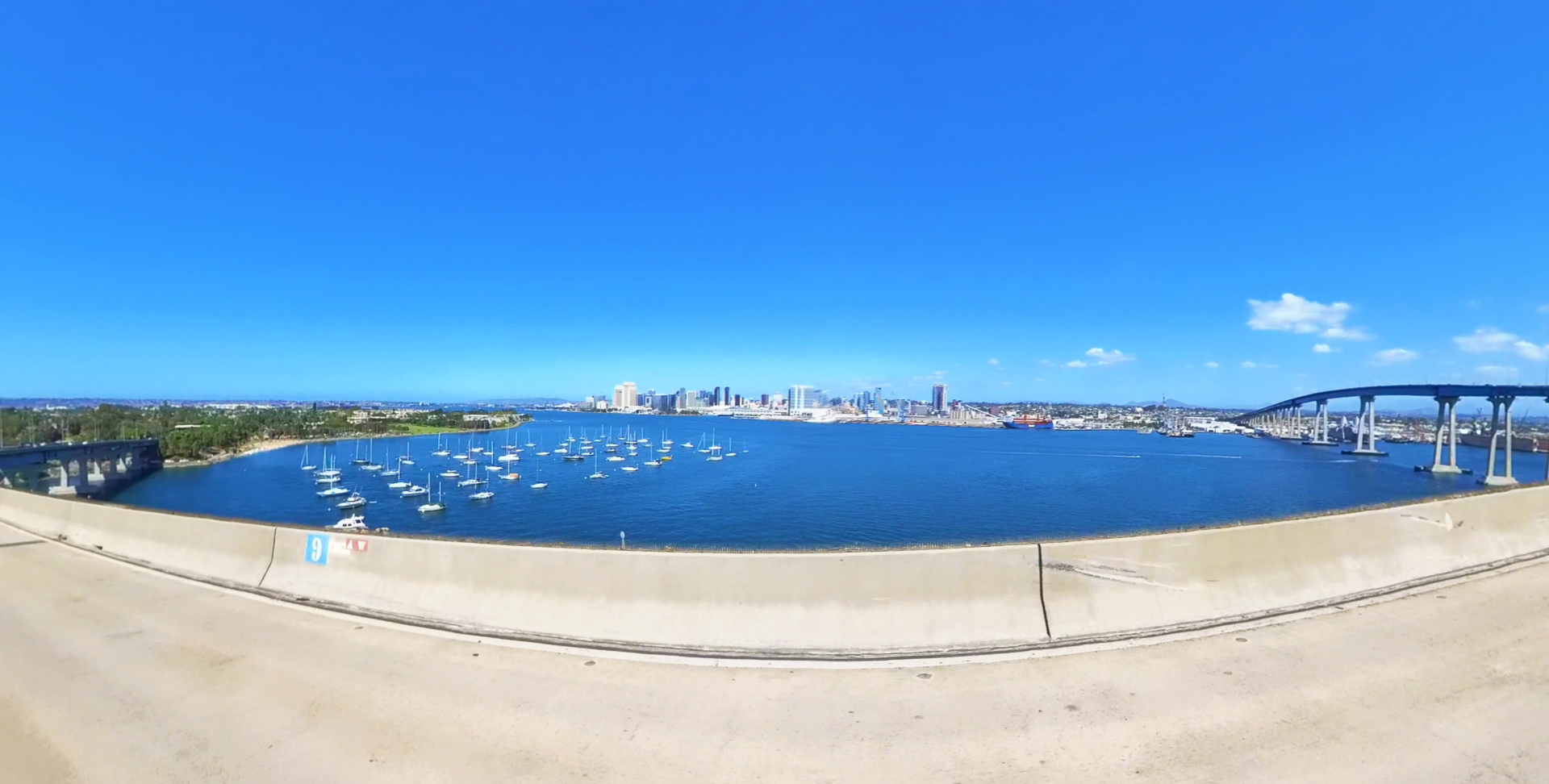
Robert Mosher’s iconic curved steel box-girder bridge spanning San Diego Bay between downtown San Diego and the Coronado peninsula.
1. The Engineering Enigma: Why Does the Bridge Curve?
Visitors frequently wonder why the Coronado Bridge does not travel in a straight line between San Diego and Coronado. The answer lies in a brilliant architectural solution to two seemingly impossible, competing U.S. Navy engineering requirements:
First, the U.S. Navy stipulated that the main navigation channel must maintain a minimum vertical clearance of 200 feet above mean high water so that massive Forrestal- and Kitty Hawk-class supercarriers could transit unhindered to the naval shipyards.
Second, state highway engineering standards dictated that the vehicular incline could not exceed a maximum gradient of 4.67% to ensure that automobiles, buses, and supply trucks could climb the span without engine overheating or transmission failures.
Because the shortest direct distance between the two shores was only 1.5 miles, a straight bridge would have had to rise far too steeply. Principal architect Robert Mosher solved the geometric puzzle by curving the bridge in a sweeping 80-degree southward arc. This elongated the span to 2.12 miles, granting the roadway enough horizontal distance to gently achieve the required 200-foot summit.
2. Modernist Aesthetics & The 1970 AISC Prize
Robert Mosher sought to ensure that the bridge would look like a sculptured ribbon gliding over the water rather than an aggressive industrial truss:
- Orthotropic Steel Box Girder: Mosher eliminated unsightly overhead steel trusses, opting instead for a continuous orthotropic steel box girder design that sits beneath the driving deck, preserving 360-degree panoramic ocean views for motorists.
- The Iconic Blue Tint: The bridge's steel girders were coated in a proprietary marine blue paint, selected to harmoniously reflect the sky and bay waters.
- AISC Most Beautiful Bridge: In 1970, the American Institute of Steel Construction awarded the Coronado Bridge its prestigious Prize Bridge Award, praising its elegance and structural purity.
3. Dedication by Ronald Reagan & The Toll Freeing
Construction began in February 1967 and took approximately thirty months at an investment of $47.6 million. On Saturday, August 2, 1969, California Governor Ronald Reagan cut the ribbon during a grand civic ceremony attended by thousands of residents from both sides of the bay.
To amortize construction bonds, Caltrans initially collected a toll of $0.60 per vehicle (westbound only; eastbound was free). The toll was subsequently adjusted to $1.00. By 2002, the construction debt was completely satisfied, and on June 27, 2002, toll collection ceased permanently, fulfilling the state's pledge to make the bridge free to the public.
4. Chicano Park at the Eastern Pylons
The construction of the bridge’s eastern ramps cut through the historic Barrio Logan neighborhood. In April 1970, community members occupied the land beneath the concrete pylons, transforming them into Chicano Park, today recognized as a National Historic Landmark containing the largest collection of outdoor Chicano mural paintings in the world.
Share Chronicle & Academic Citation
Distribute verified Coronado historical records or cite this resource in academic, educational, and journalistic works.